Last updated: September 2, 2026
Should you buy a T-money card or a Climate Card when visiting Seoul in 2026?
For most first-time visitors, the answer depends on one simple question:
Do you want maximum flexibility, or will you use Seoul public transportation many times every day?
T-money is a prepaid transportation card that works widely throughout South Korea.
The Climate Card short-term pass, on the other hand, offers unlimited rides within its covered Seoul transportation network for a fixed number of days.
For travelers who stay mainly in Seoul and take the subway or bus frequently, a Climate Card can be excellent value.
For travelers visiting several cities, taking airport transportation, or making fewer public transportation trips, T-money is usually the safer and more flexible option.
Here is how to decide.
Quick Answer
| Question | T-money | Climate Card Short-Term Pass |
|---|---|---|
| How does it work? | Pay per ride | Unlimited eligible rides during pass period |
| Where can you use it? | Widely across South Korea | Mainly Seoul and covered metropolitan routes |
| Works on Seoul subway? | Yes | Yes, within covered sections |
| Works on Seoul buses? | Yes | Seoul-licensed buses |
| Works outside Seoul? | Widely | Limited |
| Airport use | More flexible | Limited rules apply |
| Foreign credit card purchase/top-up | Regular T-money generally still relies on cash | International cards accepted for tourist short-term passes at supported machines |
| Best for | Flexible travel and multi-city trips | Frequent public transit use in Seoul |
| 1-day option | No | KRW 5,000 |
| 7-day option | No | KRW 20,000 |
What Is T-money?
T-money is Korea’s most widely recognized prepaid transportation card.
You load money onto the card and the correct fare is deducted each time you travel.
It can be used for many types of transportation, including:
Subways
City buses
Some taxis
Airport transportation
and other participating services.
One of T-money’s biggest advantages is its wide coverage.
If your trip includes not only Seoul but also other parts of South Korea, T-money is usually easier because you can continue using the same transportation card.
How Does T-money Work?
T-money works on a stored-value system.
For example, if you load KRW 30,000 onto the card, each subway or bus ride deducts the applicable fare from that balance.
When your balance becomes low, you recharge the card.
For a standard physical T-money card, Korean won cash remains the most reliable way for foreign visitors to recharge the transportation balance.
You tap the card when entering and leaving the subway.
On buses, you should also tap when boarding and getting off, especially if you want to receive eligible transfer discounts.
What Is the Climate Card?
The Climate Card is Seoul’s unlimited public transportation pass.
For international tourists and short-term visitors, the most relevant version is the short-term Climate Card.
Instead of paying separately for every subway or bus ride, you pay a fixed price for a specific number of days and can take unlimited eligible trips within the Climate Card service area during that period.
Short-term passes are available for:
1 day — KRW 5,000
2 days — KRW 8,000
3 days — KRW 10,000
5 days — KRW 15,000
7 days — KRW 20,000
These tourist short-term passes continue to be available in 2026.
Important 2026 Update: What Happened to the Climate Card?
Travelers researching this topic may see news that Seoul changed its Climate Card system in September 2026.
That is true, but it mostly affects longer-term users and Seoul residents.
Beginning September 1, 2026, Seoul introduced the new Climate Pass system as part of changes to the previous 30-day Climate Card program.
However, the tourist short-term Climate Card passes remain available.
So if you are visiting Seoul for a few days, you can still choose from the 1-, 2-, 3-, 5-, and 7-day Climate Card options.
This article focuses specifically on those tourist passes.
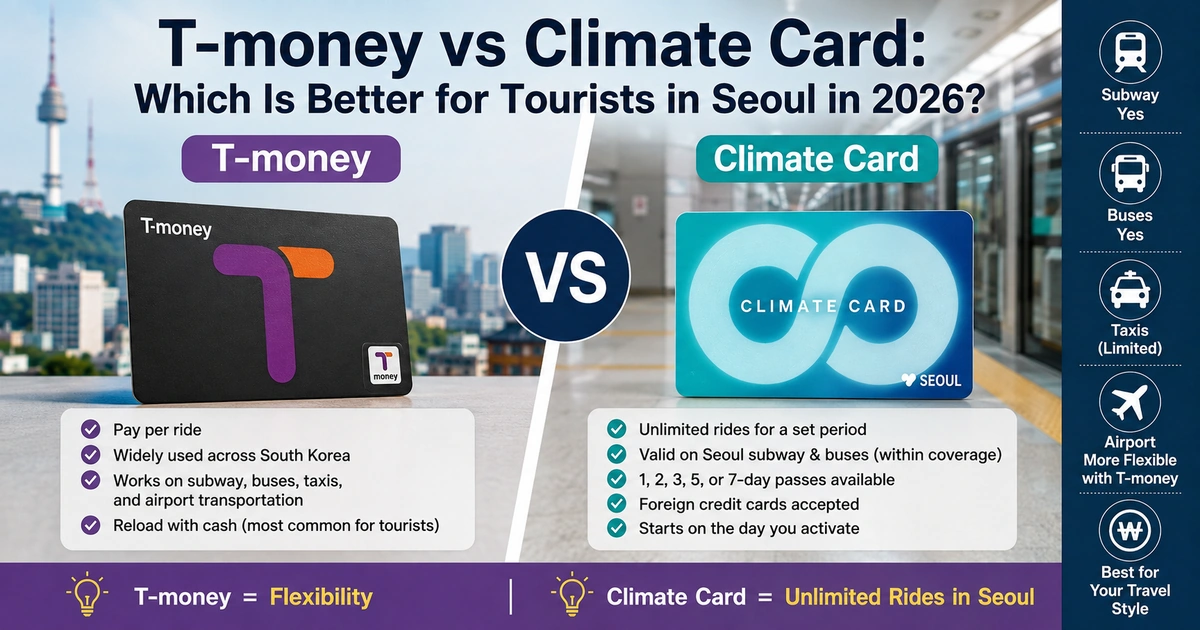
T-money vs Climate Card: The Main Difference
The easiest way to understand the two options is:
T-money = Pay for each ride
Climate Card = Pay once for unlimited eligible rides
T-money is about flexibility.
Climate Card is about unlimited usage within a defined area and time period.
That difference determines which option is better for your trip.
Which Is Cheaper?
The answer depends entirely on how often you use public transportation.
The standard adult subway base fare when using a transportation card is currently KRW 1,550.
If you only take two subway rides in a day, paying individually with T-money may cost less than buying a 1-day Climate Card.
But if you are repeatedly traveling between tourist attractions, restaurants, shopping areas, and your hotel throughout the day, the Climate Card becomes more attractive.
For example, a visitor might take:
Subway from the hotel to a palace
Subway to lunch
Subway to a shopping district
Bus to another neighborhood
Subway back to the hotel
and then another ride in the evening.
On a schedule like this, unlimited transportation can become very convenient.
The Climate Card also removes the need to think about your remaining transit balance throughout the day.
Climate Card Short-Term Pass Prices
The current tourist prices are:
1-Day Pass
KRW 5,000
Best for a very transit-heavy sightseeing day.
2-Day Pass
KRW 8,000
Useful for a short weekend or two full sightseeing days.
3-Day Pass
KRW 10,000
One of the most attractive options for travelers spending three busy days in Seoul.
5-Day Pass
KRW 15,000
Good for travelers staying most of a working week in Seoul.
7-Day Pass
KRW 20,000
Useful for travelers spending approximately one week primarily inside Seoul.
Remember that the cost of the physical Climate Card itself may be separate from the short-term pass charge.
When Does a Short-Term Climate Card Start?
This is an important detail.
A tourist short-term Climate Card starts on the day you charge the pass.
You cannot simply load a 3-day tourist pass today and choose for it to begin several days later.
For example, if you charge a 3-day pass on Monday, Monday counts as the first day.
For this reason, do not activate your Climate Card too early.
Wait until the day you actually want to begin using the unlimited transportation period.
Can Foreign Credit Cards Be Used for the Climate Card?
Yes, this became significantly easier in 2026.
International visitors can use overseas-issued credit or debit cards, including cards such as Visa and Mastercard, at supported new subway vending machines to purchase and recharge eligible Climate Card short-term passes.
This is an important advantage over regular physical T-money.
Regular T-money transportation balance still generally relies on cash for foreign tourists.
So:
T-money → cash top-up is still the safest assumption
Climate Card tourist pass → foreign credit card available at supported machines
This difference may influence your choice if you prefer to minimize cash use.
Where Does the Climate Card Work?
The Climate Card covers a large portion of Seoul’s public transportation system.
It includes:
Many Seoul subway routes
Seoul-licensed city buses
Seoul town buses
Night buses operated under Seoul licenses
and certain additional covered rail sections.
The coverage has expanded significantly since the Climate Card was first introduced.
However, it is not a nationwide transportation card.
That is one of the biggest differences from T-money.
Where Does the Climate Card NOT Work?
The Climate Card has important exclusions.
For example, it does not generally cover:
Sinbundang Line
Intercity buses
Airport buses
Buses not licensed by Seoul
and some subway routes or sections outside the Climate Card service area.
If you enter the subway within the covered zone but exit outside an eligible section, additional payment may be required.
This means travelers planning day trips outside Seoul should check their routes carefully.
What About Incheon Airport?
This is an important difference for international visitors.
T-money is generally the more flexible card for transportation involving the airport and transportation networks outside the Climate Card service area.
The Climate Card has special Airport Railroad rules.
Within the Climate Card network, the AREX section from Gimpo International Airport to Seoul Station is covered.
There are also circumstances where passengers traveling from the eligible network can exit at Incheon Airport.
However, you generally cannot start your Climate Card journey by boarding AREX at Incheon Airport Terminal 1 or Terminal 2.
So a tourist arriving at Incheon Airport should not assume the Climate Card can immediately replace an airport transportation ticket.
For your trip from Incheon Airport into Seoul, plan your airport transportation separately.
Is Climate Card Good for Day Trips Outside Seoul?
Usually, T-money is better.
Popular trips may take you beyond the Climate Card network.
Examples include destinations in:
Gyeonggi Province
Incheon
Suwon
and other regions outside central Seoul.
While some Climate Card coverage extends beyond Seoul, it does not cover every metropolitan route.
T-money offers far greater flexibility when your itinerary moves across multiple cities or regions.
Is T-money Better for First-Time Visitors?
For many first-time visitors, yes.
T-money is easy to understand:
Load money
Tap in
Tap out
Recharge when necessary
and use the same card across a wide variety of transportation systems.
There is less need to check whether each individual route falls within the specific Climate Card coverage area.
This makes T-money particularly useful for travelers with flexible or changing itineraries.
When Is the Climate Card Better?
The Climate Card becomes attractive when several conditions apply at the same time.
You are staying mainly in Seoul.
You expect to use public transportation frequently.
Most of your destinations fall within the Climate Card coverage area.
You are taking multiple rides every day.
You prefer the convenience of unlimited eligible transportation.
For travelers spending full days moving between neighborhoods such as:
Myeongdong
Hongdae
Gangnam
Jamsil
Seongsu
Itaewon
Gwanghwamun
Dongdaemun
and other areas within Seoul, the Climate Card can be extremely convenient.
When Is T-money Better?
Choose T-money if:
You are visiting several Korean cities.
Your public transportation use will be relatively light.
You want one transportation card that works across a wider area.
You plan several trips outside Seoul.
You use airport buses or transportation that is not included in Climate Card coverage.
You prefer not to calculate whether an unlimited pass will save money.
T-money is also useful as a backup even if you purchase a Climate Card.
Can You Carry Both T-money and a Climate Card?
Yes.
In fact, this can be a practical setup.
Some travelers use:
Climate Card for regular sightseeing within Seoul
and
T-money as a backup for transportation outside the Climate Card coverage area.
For example, you might use the Climate Card for several days of sightseeing in Seoul and keep a T-money card available for a trip to another city.
The important thing is to make sure you tap the correct card when entering public transportation.
What About Buses?
T-money works broadly on participating bus systems.
The Climate Card covers Seoul-licensed city and town buses, including eligible night buses.
One interesting rule is that a Seoul-licensed bus can still be covered even if part of the journey travels outside Seoul.
However, buses licensed by other regions are generally not covered just because they happen to pass through Seoul.
For tourists, it is not always obvious which local government licenses a particular bus.
T-money avoids this issue because you simply pay the regular fare.
What About Subway Transfers?
T-money is integrated into Korea’s transportation fare system.
When used correctly, eligible transfers between buses and subways can receive transfer benefits.
You need to tap both when getting on and when getting off.
With the Climate Card, the goal is different.
Because eligible transportation is unlimited during the pass period, you do not need to calculate the individual fare for every covered journey.
You should still tap properly when boarding and leaving transportation.
Does the Climate Card Include Seoul Bike?
Not on the standard tourist short-term passes discussed here.
The 1-, 2-, 3-, 5-, and 7-day short-term Climate Card passes do not include Ttareungi, Seoul’s public bicycle system.
They also do not include the Hangang Bus option.
This is different from some longer-term Climate Card or Climate Pass configurations.
So tourists should not assume that every service associated with the Climate Card brand is included in the short-term pass.
What Should You Choose for a 3-Day Seoul Trip?
For a traveler spending three full sightseeing days almost entirely in Seoul, the 3-day Climate Card at KRW 10,000 can be attractive.
This is especially true if you intend to move around frequently throughout the day.
However, if your three-day itinerary includes:
A day trip outside Seoul
Very little subway travel
Taxi-heavy transportation
or airport transportation
then T-money may still be more practical.
What Should You Choose for a 5- to 7-Day Trip?
For a 5- to 7-day stay primarily focused on Seoul, the Climate Card deserves serious consideration.
The 5-day pass costs KRW 15,000.
The 7-day pass costs KRW 20,000.
If you make several eligible public transportation journeys every day, this can provide excellent value.
But if half of your trip involves destinations outside Seoul, T-money may be more useful despite the pay-per-ride system.
What If You Are Visiting Busan or Other Cities Too?
Choose T-money as your main transportation card.
T-money can be used across public transportation networks in many parts of South Korea.
The Climate Card is specifically designed around Seoul and certain included metropolitan routes.
So an itinerary such as:
Seoul
Busan
Gyeongju
Jeonju
or
other cities
strongly favors T-money.
You could still use a short-term Climate Card specifically during your Seoul portion if the numbers make sense.
Can Families Share One Climate Card?
No.
Each person needs their own transportation card when traveling.
You cannot use one Climate Card as an unlimited pass for several travelers.
The same practical rule applies when tapping into Seoul’s subway system: each passenger should have an appropriate individual fare medium.
T-money vs Climate Card: Best Choice by Traveler Type
Choose T-money if you are:
Visiting Korea for the first time
Traveling beyond Seoul
Taking only a few subway or bus rides per day
Using airport transportation frequently
Changing your itinerary often
Looking for the simplest flexible option
Choose the Climate Card if you are:
Staying mainly in Seoul
Taking public transportation many times each day
Doing intensive sightseeing
Using mostly covered subway and Seoul bus routes
Staying for 1, 2, 3, 5, or 7 days
Looking for predictable transportation spending
My Simple Recommendation
If you are unsure, start with T-money.
It is the safer all-purpose choice for most international visitors.
If you look at your itinerary and realize that you will spend several consecutive days traveling repeatedly around Seoul, consider purchasing a Climate Card short-term pass for those days.
You do not necessarily have to choose one card for your entire Korean vacation.
Using the right card for each part of the trip can be the most efficient approach.
Frequently Asked Questions
Is T-money or Climate Card cheaper?
It depends on how frequently you use public transportation.
T-money charges for each ride.
The Climate Card provides unlimited eligible rides for a fixed period.
Heavy transit users in Seoul may save money with the Climate Card.
Can tourists buy a Climate Card in 2026?
Yes.
The tourist short-term Climate Card remains available in 1-, 2-, 3-, 5-, and 7-day options.
Did the Climate Card end in September 2026?
The previous 30-day prepaid program changed with the introduction of Climate Pass, but the tourist short-term Climate Card continues.
Can I buy a Climate Card with a foreign Visa or Mastercard?
Yes, eligible short-term Climate Card products can be purchased or recharged using international credit and debit cards at supported subway vending machines.
Can I use Climate Card from Incheon Airport?
Do not rely on it as your primary way to travel from Incheon Airport into Seoul.
Special Airport Railroad rules apply, and boarding at Incheon Airport Terminal 1 or Terminal 2 is generally not included.
Can Climate Card be used in Busan?
No.
For multi-city travel, T-money is far more appropriate.
Does Climate Card cover the Sinbundang Line?
No.
The Sinbundang Line is one of the important exclusions.
Can I use T-money and Climate Card on the same trip?
Yes.
You can use a Climate Card for high-frequency travel within Seoul and keep T-money for other transportation.
Final Thoughts
There is no single winner in the T-money vs Climate Card comparison.
For most travelers:
T-money wins on flexibility.
Climate Card wins on unlimited Seoul transportation.
If you are visiting several cities or taking only a few rides per day, T-money is probably the better choice.
If you are spending several busy sightseeing days in Seoul and using buses and subways repeatedly, the Climate Card short-term pass can be excellent value.
The simplest strategy is:
Use T-money as your flexible all-purpose transportation card, and consider a Climate Card only when your Seoul itinerary is intensive enough to benefit from unlimited travel.