Last updated: September 1, 2026
Planning a trip to South Korea in 2026 and confused about whether you need a K-ETA, an e-Arrival Card, or both?
You are not alone.
The two systems are often mentioned together, but they serve completely different purposes.
The easiest way to remember the difference is:
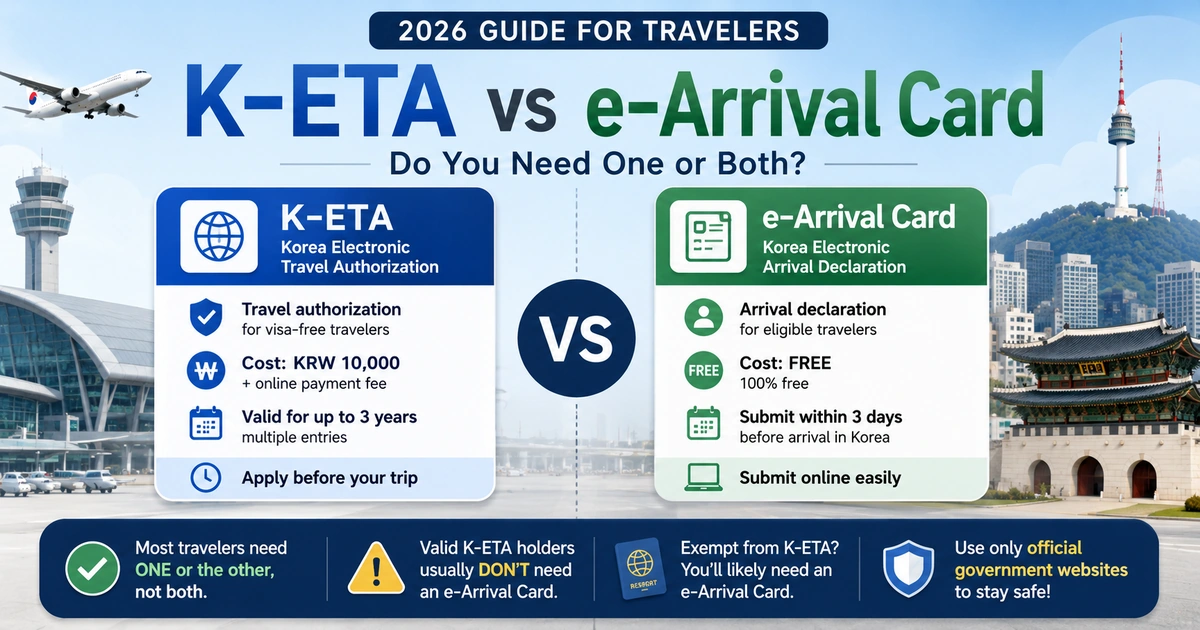
K-ETA = Travel authorization
e-Arrival Card = Arrival declaration
For many travelers, you will need one or the other — not both.
However, South Korea’s temporary K-ETA exemption has been extended through the end of 2026, which makes the rules slightly more confusing.
This guide explains the difference and helps you determine what you need before your trip to Korea.
Quick Answer
| Question | Answer |
|---|---|
| What is K-ETA? | Electronic travel authorization for eligible visa-free travelers |
| What is the e-Arrival Card? | Korea’s electronic arrival declaration |
| Is K-ETA free? | No. The official fee is KRW 10,000 plus a small online payment fee |
| Is the e-Arrival Card free? | Yes |
| Do valid K-ETA holders normally need an e-Arrival Card? | No |
| Do travelers temporarily exempt from K-ETA need an e-Arrival Card? | Generally yes, unless another exemption applies |
| Is the K-ETA exemption still available in 2026? | Yes, for eligible countries and regions through December 31, 2026 |
| Do Korean Residence Card holders need an e-Arrival Card? | No |
| Can I voluntarily apply for K-ETA if I am temporarily exempt? | Yes |
What Is K-ETA?
K-ETA stands for Korea Electronic Travel Authorization.
It is a travel authorization for nationals of eligible countries who want to enter South Korea without a visa.
Think of it as permission to travel to Korea under a visa-free entry program.
K-ETA itself is not a visa, and receiving K-ETA approval does not guarantee entry into South Korea. The final decision is still made by Korean immigration authorities when you arrive.
The official K-ETA application fee is KRW 10,000 per person, plus a small online payment processing fee.
K-ETA approval is generally valid for three years, or until your passport expires if your passport expires sooner.
During its validity period, a K-ETA can generally be used for multiple trips to Korea.
What Is the Korea e-Arrival Card?
The Korea e-Arrival Card is completely different.
It is an electronic version of the arrival declaration traditionally completed by foreign visitors entering Korea.
Instead of completing a paper arrival card at the airport or on the airplane, eligible travelers can submit their information online before arrival.
The e-Arrival Card is:
Free
Submitted online
Available from three days before arrival in Korea
It asks for information such as your passport details, travel schedule, and accommodation or stay information in Korea.
Once successfully submitted, you normally do not need to complete a separate paper arrival declaration for the same entry.
K-ETA vs e-Arrival Card: The Main Difference
Here is the simplest comparison.
K-ETA
- Purpose: Travel authorization
- Cost: KRW 10,000 plus payment processing fee
- Used by: Eligible visa-free travelers who are required or choose to obtain K-ETA
- Validity: Generally up to three years or passport expiration
- When to apply: Before traveling to Korea
e-Arrival Card
- Purpose: Arrival declaration
- Cost: Free
- Used by: Foreign travelers required to submit an arrival declaration
- Validity: For the specific entry declaration
- When to submit: Within three days before arrival in Korea
- The most important difference is that K-ETA determines travel authorization, while the e-Arrival Card provides arrival information to Korean immigration.
Do You Need Both K-ETA and an e-Arrival Card?
In most common tourist situations, no.
If you have a valid K-ETA and are entering Korea under your K-ETA eligibility, you are generally exempt from submitting an e-Arrival Card.
This is one of the practical benefits of having an approved K-ETA.
So:
Valid K-ETA → Normally no e-Arrival Card
However, there is an important exception.
If you hold a K-ETA but are entering Korea using a visa, Korean immigration rules state that you are generally required to complete an e-Arrival Card because you are being admitted under the visa rather than your K-ETA.
What About the K-ETA Temporary Exemption in 2026?
This is where many travelers get confused.
South Korea has extended its temporary K-ETA exemption for eligible countries and regions through:
December 31, 2026
If your nationality is covered by the temporary exemption, you may be able to enter Korea without applying for K-ETA.
However:
K-ETA exemption does not automatically mean e-Arrival Card exemption.
In fact, travelers entering Korea under the temporary K-ETA exemption are generally among those required to submit an arrival declaration unless another exemption applies.
So the typical situation is:
Temporarily K-ETA exempt → No K-ETA application → Submit e-Arrival Card
This distinction is extremely important for travelers visiting Korea in 2026.
Can You Still Apply for K-ETA If You Are Exempt?
Yes.
If your country or region is currently covered by the temporary K-ETA exemption, you can still voluntarily apply for a K-ETA.
You will need to pay the normal K-ETA application fee.
Why would someone do this?
One practical benefit is that a traveler entering with a valid K-ETA generally does not need to submit an arrival declaration.
For a single trip, many tourists may simply prefer to use the free e-Arrival Card instead.
But frequent travelers to Korea may find a valid K-ETA more convenient because it can generally be used for multiple trips during its validity period.
How Much Does Each One Cost?
The cost difference is simple.
K-ETA
The official application fee is:
KRW 10,000 per person
An additional online payment fee is normally charged.
The K-ETA application fee is non-refundable even if the application is denied.
e-Arrival Card
Free
There is no official government application fee for Korea’s e-Arrival Card.
Be cautious if a website asks you to pay to submit an e-Arrival Card.
The Korean government has warned travelers about unofficial websites impersonating the official service.
How Long Does K-ETA Approval Take?
The official K-ETA guidance states that assessment generally takes within 72 hours.
However, processing can take longer depending on application volume or individual circumstances.
There is no official expedited K-ETA service that guarantees faster processing for a particular traveler.
For that reason, if you actually need K-ETA, do not wait until you are at the airport to apply.
When Should You Submit an e-Arrival Card?
The e-Arrival Card can be submitted within three days before your scheduled arrival in South Korea, based on Korea Standard Time.
It cannot simply be completed months in advance.
For example, if your trip to Korea is several weeks away, you do not need to submit it yet.
Wait until your eligible submission window opens shortly before arrival.
Who Usually Needs an e-Arrival Card?
Examples include:
Travelers entering Korea with a valid Korean visa
Travelers temporarily exempt from K-ETA
Certain travelers otherwise exempt from applying for K-ETA
There are additional categories, so travelers with unusual immigration status should check Korea’s official e-Arrival Card eligibility guidance.
Who Is Exempt From the e-Arrival Card?
Common exemptions include:
Korean citizens
Korean nationals do not submit an e-Arrival Card.
Korean Residence Card holders
Travelers holding a valid Korean Residence Card, Permanent Resident Card, or eligible Overseas Korean Resident Card are generally excluded.
Valid K-ETA holders
Travelers entering under a valid K-ETA are generally excluded from the arrival declaration requirement.
Remember the important exception:
If you have a K-ETA but enter Korea using a visa, you may still need to submit an e-Arrival Card.
There are also exemptions for certain group travelers, airline crew members, and other specific categories.
Which One Do I Need? Simple Examples
Here are some common scenarios.
Scenario 1: You are temporarily exempt from K-ETA in 2026
You do not apply for K-ETA.
You will generally submit an e-Arrival Card before arriving in Korea.
Scenario 2: You already have a valid K-ETA
You generally do not need an e-Arrival Card when entering under your K-ETA.
Check that your K-ETA is still valid and linked to your current passport.
Scenario 3: You have a Korean tourist visa
You generally need to submit an e-Arrival Card.
A Korean visa and an e-Arrival Card perform different functions.
Scenario 4: You have a Korean Residence Card
You generally do not need an e-Arrival Card.
Scenario 5: You are K-ETA-exempt but voluntarily apply for K-ETA
Once you have a valid K-ETA and enter under it, you generally do not have to submit the arrival declaration.
However, you have paid the K-ETA application fee instead of using the free e-Arrival Card process.
Should You Apply for K-ETA Just to Avoid the e-Arrival Card?
For most travelers making a single trip during the 2026 temporary exemption period, there may be little reason to pay for K-ETA solely to avoid completing a free e-Arrival Card.
The e-Arrival Card is free and can be completed online shortly before arrival.
However, someone who visits Korea frequently may prefer having an approved K-ETA because it is generally valid for multiple entries during its validity period.
Your best choice depends on:
How often you travel to Korea
Whether your nationality is currently K-ETA exempt
Your passport expiration date
Your visa status
Whether you prefer completing an arrival declaration for each applicable trip
Be Careful With Unofficial Websites
Both K-ETA and the Korea e-Arrival Card have attracted unofficial websites that may look similar to government services.
For K-ETA, use Korea’s official K-ETA service.
For the e-Arrival Card, use Korea’s official e-Arrival Card service.
This is particularly important because:
The official e-Arrival Card is free.
If you are being asked to pay a substantial amount for an e-Arrival Card, stop and check the website carefully.
Likewise, the standard official K-ETA fee is KRW 10,000 plus the normal online payment fee.
Frequently Asked Questions
Is K-ETA the same as the e-Arrival Card?
No.
K-ETA is an electronic travel authorization, while the e-Arrival Card is an arrival declaration.
Is K-ETA free in 2026?
No.
The official K-ETA application fee is KRW 10,000 per person plus an online payment fee.
Is the Korea e-Arrival Card free?
Yes.
The official Korean government e-Arrival Card is free.
Does everyone need K-ETA in 2026?
No.
South Korea has extended the temporary K-ETA exemption for eligible countries and regions through December 31, 2026.
If I am K-ETA exempt, do I need an e-Arrival Card?
Generally yes, if you are required to submit an arrival declaration and do not fall under another exemption.
If I already have a valid K-ETA, do I need an e-Arrival Card?
Generally no, provided you are entering Korea under your K-ETA rather than using a visa.
Can I have both a K-ETA and a visa?
It is possible to hold a K-ETA and a visa, but if you enter Korea using the visa, you should follow the immigration requirements applicable to the visa, including the e-Arrival Card requirement where applicable.
Final Thoughts
The easiest way to remember the difference is:
K-ETA = permission to travel under Korea’s visa-free system
e-Arrival Card = declaration of your arrival information
For many tourists visiting South Korea in 2026, the temporary K-ETA exemption means the process will be:
No K-ETA application → Free e-Arrival Card before arrival
Travelers who already hold a valid K-ETA will generally not need to submit an e-Arrival Card.
Because immigration policies can change, always check the official Korean government websites shortly before traveling.